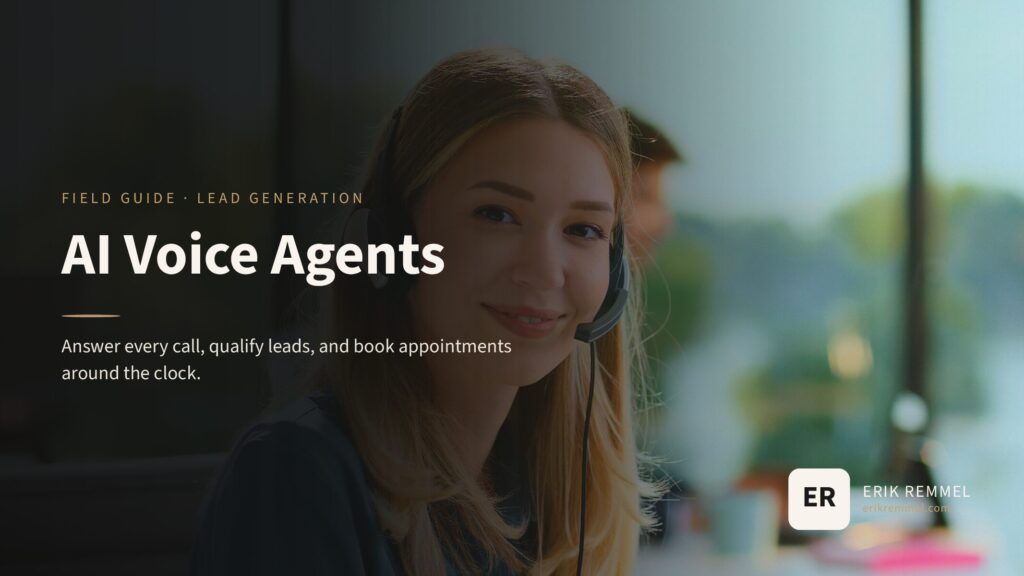
Voice agents answer every call, qualify callers against our rules, and book appointments straight into the calendar, day or night. We run these for dentists, contractors, and law firms inside Helium Digital’s managed setup, pairing scripts with real scheduling logic so staff only handle calls that truly need a human.
In this article
- Key Takeaways
- Why Are Leads Going Cold Before You Call Back?
- What actually makes a lead go cold?
- What Does an AI Voice Agent Actually Do?
- Can an AI voice agent handle a real conversation, not just a script?
- How Does Voice Lead Qualification Work in Real Calls?
- What questions does an AI voice agent actually ask?
- Does voice qualification replace a receptionist?
- Can Automated Appointment Calls Fill Your Schedule?
- Do automated calls actually reduce no-shows?
- What should a clinic look for in voice AI for bookings?
- Is Voice AI for Bookings Worth It for Your Business?
- Does voice AI actually qualify leads before booking them?
- What about callers who don’t speak English?
- FAQ
- Why do leads go cold before a callback?
- What does an AI voice agent do for lead qualification?
- Who runs these AI voice agent setups?
- Conclusion
Key Takeaways
- AI voice agents qualify leads 24/7, automating inbound scoring and routing to purchase-ready prospects.
- Real sales conversations require handling interruptions, unexpected questions, and prospect pushback effectively.
- HIPAA-compliant voice agents deliver natural-sounding support for medical practices with automated scheduling.
- Lead qualification systems identify and score prospects, enabling better conversion rates for small teams.
Why Are Leads Going Cold Before You Call Back?
Leads go cold because the gap between a form fill and a human voice gives prospects time to call someone else. That gap used to cost a sale now and then. Today it costs the whole relationship. That same prospect has likely already scheduled with a competitor before anyone on staff finishes their coffee.
We’ve spent twenty years helping businesses get found and grow. The lesson hasn’t changed: speed wins, attention loses to speed. What’s changed is how fast “fast” now needs to be. We work with dentists, contractors, lawyers, med spas, accountants, and real estate brokers. The firms that respond first almost always win the booking, regardless of who had the better pitch.
What actually makes a lead go cold?
A lead cools the moment doubt creeps in, usually somewhere between minute five and hour one. Prospects start assuming no answer means disinterest or disorganization, so they move on.
Here’s what typically happens during a slow callback window:
- The prospect calls two more competitors while waiting
- One of those competitors answers live and books the appointment
- The original business calls back to an unavailable or uninterested lead
AI voice agents close that window by picking up immediately, every time, without needing a staff member free at that exact minute. That’s the whole fix: remove the wait, not just shorten it.
What Does an AI Voice Agent Actually Do?
A real AI voice agent places outbound calls, qualifies leads against the criteria a business sets, and books the meeting straight onto a calendar, without a human touching the phone. We’ve watched this move from a novelty to something that actually changes how a front desk or sales line operates. Instead of one rep dialing one prospect at a time, the system runs hundreds of calls in parallel and only hands back the leads worth a human’s time.
That’s the pitch. The harder question is whether it holds up on a messy, real call.
Can an AI voice agent handle a real conversation, not just a script?
Prospects interrupt. They ask questions nobody wrote into the script, and they push back on price or timing. Plenty of tools claim to automate this kind of outbound work. Most fall apart the moment a caller goes off-script. The ones worth using handle voice lead qualification the way a decent SDR would: they listen, adjust, and still steer toward a booked slot.
At Helium Digital, we treat this as one piece of a bigger job: getting a service business found in Google and in AI search, then making sure what happens after the phone rings actually converts. That’s the conversion-ready part our team, including Life Improvement Media, builds around. A voice agent that qualifies well but never books anything isn’t doing its job. The call only matters if it ends on the calendar.
How Does Voice Lead Qualification Work in Real Calls?
Real calls follow a simple pattern: the system answers, asks a handful of qualifying questions, and routes the lead based on the answers. Voice lead qualification works around the clock, not just nine to five. A prospect calling at 9pm on a Sunday still gets screened instead of hitting voicemail. That alone changes how many leads actually turn into booked work for a contractor or a dental practice.
We’ve watched this play out across five years of agency work with dentists, contractors, and other service businesses. None of it taught us that cleverness wins. What won, every time, was consistency and repetition, the boring parts nobody wants to talk about at a marketing conference. Voice qualification tools are no different. They succeed or fail based on whether they ask the same good questions every time, not on how slick the demo sounds.
What questions does an AI voice agent actually ask?
Most systems confirm the basics first: service needed, location, timeline, and budget range. From there, automated appointment calls branch based on the answer, either pushing toward a booking or flagging the lead for a human follow-up.
Does voice qualification replace a receptionist?
Not in our experience. It handles the repetitive screening so a receptionist or office manager can focus on the calls that need real judgment, like voice ai for bookings that involve insurance questions or custom pricing. We treat it as a filter, not a replacement.
Can Automated Appointment Calls Fill Your Schedule?
Automated appointment calls fill gaps in a schedule, but they don’t fix a broken intake process underneath. We’ve watched ai voice agents handle the grunt work of booking, around the clock patient support, scheduling, and compliant communication. Staff aren’t stuck answering the same five questions all day. That matters most for medical offices, where a missed call often means a missed patient entirely.
We built our original agency, Life Improvement Media, working directly with dentists, contractors, and other service businesses in the Tampa Bay area. That hands-on experience taught us something software vendors rarely admit: voice lead qualification only works if someone designs the call flow around how real patients actually talk, not how a script assumes they will.
Do automated calls actually reduce no-shows?
A secure, always-on answering setup cuts wait times and stops calls from going unanswered, which is where most no-shows start. When a caller reaches a person or a well-built voice agent immediately instead of sitting on hold, they’re far more likely to confirm and keep the appointment.
What should a clinic look for in voice AI for bookings?
We care about three things when we set up automated appointment calls for clients:
- Protecting patient information during every exchange
- Routing urgent calls to a human fast
- Confirming and rescheduling without extra staff involvement
The schedules that fill reliably are the ones where voice ai for bookings is paired with a real follow-up process, not left to run alone.
Is Voice AI for Bookings Worth It for Your Business?
Yes, for most local service businesses the math works in favor of voice AI for bookings. Missed calls cost more than the tool does. We started in marketing long before any of this existed. We judge every new tool against years of watching what actually moves revenue. Voice AI earns a place on that list.
Here’s the shift that matters. AI voice agents have moved past the experimental bot phase. Systems built for follow-up and booking now handle production-level call volume every single day, not demo calls in a controlled test environment. That maturity is what makes automated appointment calls viable for a dental office or a contractor crew instead of a risky experiment.
Does voice AI actually qualify leads before booking them?
Yes. Voice lead qualification means the system asks the same screening questions a front desk person would, every time, without getting tired or skipping steps on a busy Friday. That consistency is the real value, not novelty.
What about callers who don’t speak English?
Bilingual reception options exist specifically so calls get answered in the caller’s own language instead of routing to voicemail. For practices in diverse markets, that alone can save bookings that would otherwise walk to a competitor.
A few questions worth asking before adopting it:
- Does it integrate with the scheduling system already in place?
- Can it handle objections, not just scripted intake?
- Does it support more than one language?
Helium Digital runs six brands built around helping service businesses get found without adding headcount. We treat voice AI the same way: a tool that earns its keep, not a gadget for its own sake.
FAQ
Why do leads go cold before a callback?
The gap between a form fill and a human response gives prospects time to call competitors. Doubt sets in quickly, and prospects assume no answer means disinterest, so they move on and book elsewhere.
What does an AI voice agent do for lead qualification?
The agent answers calls, qualifies callers against set criteria, and books appointments directly onto the calendar without a human touching the phone. It runs this day or night, handling conversations the way a decent SDR does.
Who runs these AI voice agent setups?
Erik Remmel, based in Sarasota, Florida, runs these voice agents inside Helium Digital’s managed setup for dentists, contractors, and law firms, pairing scripts with real scheduling logic.
Conclusion
In closing, voice agents work best when they handle what humans find tedious, not when they replace the judgment call. A qualification script that asks the right questions and books the appointment saves your team hours every week. The real win isn’t the technology itself, it’s the pipeline that stays full because leads move faster and your people focus on closing deals instead of playing phone tag.

Download the Local Service Pipeline Playbook.
The end-to-end AI lead capture-to-close workflow we install on every Launched account.
Get the playbook