

I’ve spent more than twenty years in marketing, and I’ve never seen a shift happen this fast. Your customers used to type a question into Google. Now a growing number of them ask ChatGPT, Perplexity, or Google’s AI Overviews instead, and whatever business that AI names in its answer is the one that gets the call. This guide is about how you become that business.
In this article
- Key Takeaways
- What This Guide Covers
- Who Is This For?
- Do You Need Technical Skills?
- What Does It Mean to Show Up in AI Search?
- Is This the Same Thing as SEO?
- Why This Matters for Your Business
- Is AI Search Really Different From SEO?
- Do You Need a Separate Strategy?
- How to Audit Your Current AI Visibility
- How to Structure Content for AI
- Does Structure Matter More Than Good Writing?
- How Often Should You Update This?
- How to Build Trust With AI Systems
- Does AI Trust Older Content More?
- How to Track Your AI Visibility Results
- What Should You Look For?
- Does This Work the Same for Every Business?
- Mistakes That Sink Local AI Visibility
- Why Consistency Beats Clever Tactics
- FAQ
- What is AI visibility?
- Do I need technical skills to use this guide?
- Who is this guide for?
- Conclusion
I’m Erik Remmel. I co-founded Helium Digital in 2018 with my partner, Ernie Bilodeau. We now serve more than 1,000 clients across six brands under Helium. Our clients are the local service businesses you’d expect: dentists, contractors, lawyers, med spas, accountants, real estate brokers, and we track how those businesses show up in AI answers every single day. This site is my personal place to write about what’s actually working, without the sales pitch.
Key Takeaways
- Customers are asking AI assistants questions instead of typing them into Google, and if AI doesn’t name your business, you’re invisible to them.
- Google’s AI Overviews and AI Mode run on the same core ranking systems as regular search, so your SEO fundamentals still matter.
- ChatGPT Search now shows up as a real referral source in your analytics, which means you can finally measure this instead of guessing.
- Getting mentioned by AI comes down to the same things that always built trust: clear answers, accurate business information, and a track record that holds up.
What This Guide Covers
I built this around one goal: helping local service businesses get found and grow without hiring a big team or a full marketing department. No talk about algorithms nobody actually understands. Just what’s working right now for the industries I work with every day.
Here’s what I’ll walk through:
- How showing up for a local business is different now than just ranking for keywords
- What to actually do first, in plain terms
- Where reviews and local trust signals fit into the answers AI gives
Who Is This For?
Business owners running high-touch service businesses, not enterprise marketing teams with a budget to burn. I’m based in Sarasota, Florida, and everything here is written from that seat, not from a corporate office.
Do You Need Technical Skills?
No. I wrote this assuming you’re running a business, not a marketing department. I’ll turn the technical stuff into plain decisions you can make this week.
What Does It Mean to Show Up in AI Search?
It means that when someone asks ChatGPT, Perplexity, or Google’s AI Overviews a question your customer would ask, your business gets named in the answer. That’s it. Not where you rank on a page, but whether the AI actually says your name.
Here’s why I stopped treating this as optional. ChatGPT has around 900 million weekly users now, and it’s closing in on a billion. Google’s AI Overviews reach more than 2 billion people a month in over 200 countries. A dentist or contractor who isn’t showing up in those answers is invisible to a massive and growing chunk of the people looking for help.
Is This the Same Thing as SEO?
Not quite. Old-school SEO is built around rankings and blue links. This is built around whether an AI answer names your business at all when someone asks “best contractor near me” or “dentist who takes emergency patients.”
Why This Matters for Your Business
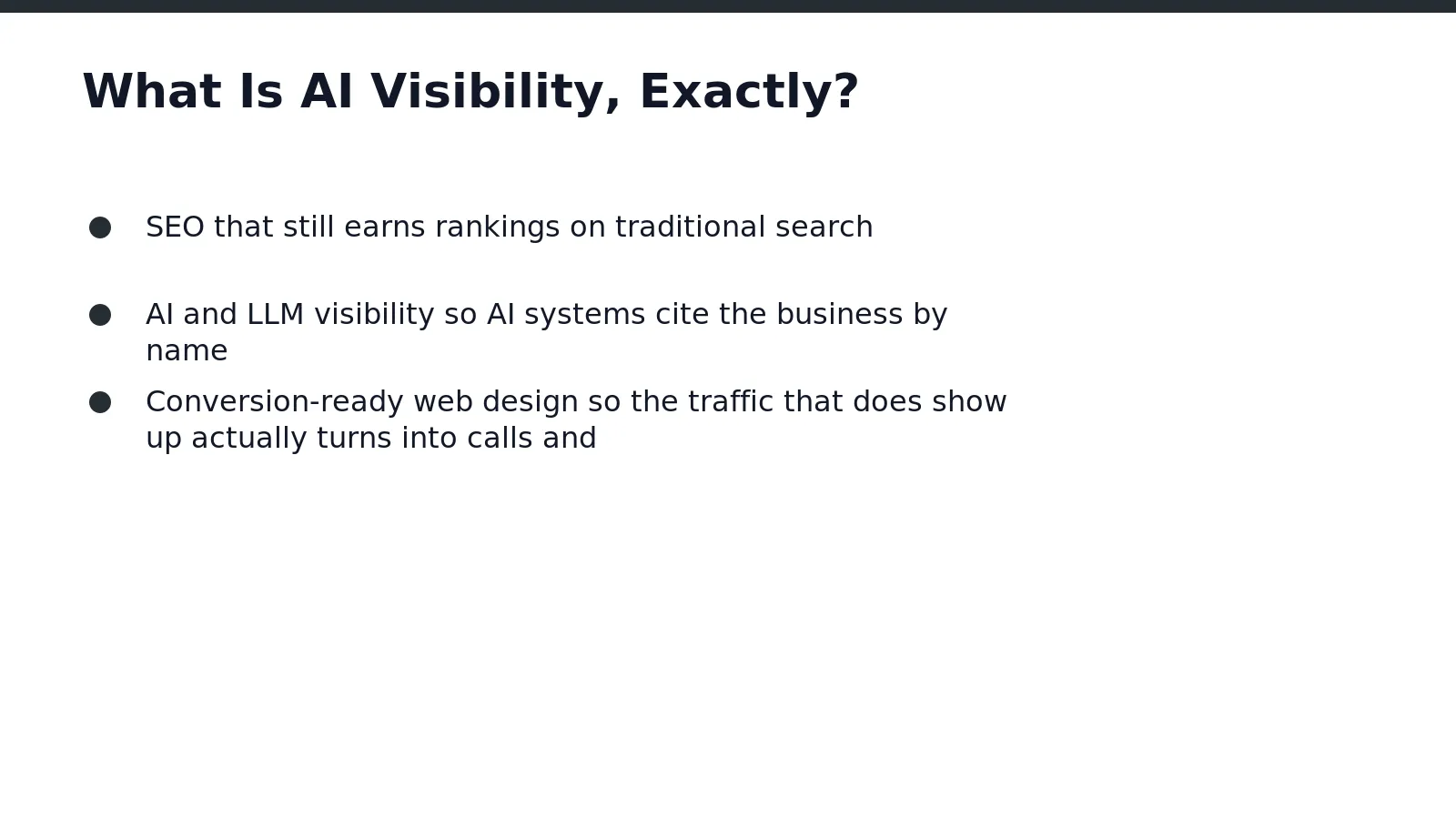
Because your competitor down the street might already be the one AI mentions. Meanwhile you’re still arguing about ranking higher on a page fewer people scroll through anymore. At Helium, we treat this as one connected problem: SEO that still earns rankings, AI visibility so these tools mention you by name, and a website that actually turns that traffic into calls. Skip any one of the three and the other two do a lot less for you.

Is AI Search Really Different From SEO?
No, and yes. The fundamentals don’t change. Google says outright that its AI features run on the same core ranking and quality systems it’s always used. So I’m not telling clients to throw out what already works. I’m telling them to add a second scoreboard next to the old one.
A dentist can rank third on Google and still never get mentioned when someone asks an AI assistant who’s a good dentist nearby. Those are two different games, running on the same fundamentals but scored differently.
Do You Need a Separate Strategy?
Not separate, bigger. I’ve run agencies for twenty years, and the lesson never changes: consistency beats clever tricks. That means clean, accurate business information everywhere it appears online, content that actually answers the questions your customers ask, and reviews that build real trust instead of shortcuts.
How to Audit Your Current AI Visibility
A real audit starts with two questions: where do you already show up, and where are you invisible. That takes about an hour, not a week of guesswork.
The good news is the data finally exists. Google Search Console now breaks out AI visibility as its own reporting line, separate from regular organic impressions and clicks. Check that number first. Then pull your referral data and look for ChatGPT Search showing up as a source. That channel used to be invisible. Now it leaves a trail.
Here’s what to check:
- Pull impressions from Search Console’s AI section, not just the standard performance tab. Note: this report shows impressions only, not clicks.
- Check your analytics for ChatGPT Search and any other AI-driven referral traffic.
- Ask ChatGPT and Google’s AI Mode the actual questions your customers ask, and note whether you get mentioned.
- See who does get mentioned when you don’t. That’s your real competition now.
How to Structure Content for AI
Structure starts with knowing who’s reading the page, not with heading tricks. Google says the same thing: figure out who you’re writing for, then answer what they’re actually asking.
Here’s the order I use:
- Write down the exact question a real customer would ask.
- Answer it in the first two sentences. No throat-clearing.
- Add one detail a competitor’s page doesn’t have. Something specific.
- Repeat that for every subtopic, one question per section.
Does Structure Matter More Than Good Writing?
No. I’ve watched clients obsess over headings and formatting while ignoring whether the page actually answers the question. Structure without a real answer underneath it gets ignored by AI the same way it gets ignored by people.
How Often Should You Update This?
Less often than you’d think. Chasing every new AI trend burns time a contractor doesn’t have. I’d rather see a law firm publish five well-answered pages a year than twenty half-finished ones.
How to Build Trust With AI Systems
Trust comes from a track record that holds up, not a clever prompt. I built my approach the slow way, starting with an agency in Tampa Bay, and that history matters more now than it ever did with plain old Google rankings.
AI models reward consistency over time. A business that shows up the same way across its website, its reviews, and everywhere else for years reads differently to these tools than one that changed its story last month. Going from that first agency to six brands and more than 1,000 clients gives us a track record AI systems can actually check.
Here’s what I tell clients to focus on:
- Keep your service pages, pricing, and location details current. Don’t set it and forget it.
- Organize your content so a machine, or a person, can pull a clean answer: real questions as headings, short direct answers underneath.
- Back up your claims. Real credentials, licenses, years in business, actual results.
Does AI Trust Older Content More?
Age by itself doesn’t buy you anything. What matters is whether the content stays accurate and gets revisited. A five-day-old page that’s right beats a five-year-old page that’s wrong.
How to Track Your AI Visibility Results
Tracking means running the same test questions through ChatGPT, Perplexity, and Google’s AI Overviews every month and writing down whether your business shows up. Miss a month and you won’t know you dropped off until a client tells you they couldn’t find you anywhere.
Here’s the process I actually use:
- Write down 10 to 15 real questions your customers ask. Not keywords, questions.
- Run each one through ChatGPT, Perplexity, and Google AI Overviews.
- Record whether you get named, and where you land if there’s a list.
- Note which competitor gets mentioned instead, if any.
- Repeat monthly and watch the trend, not one snapshot.
What Should You Look For?
Repeat mentions, not one-off wins. A single mention means nothing. Showing up across multiple questions and multiple months means you’ve actually built something real.
Does This Work the Same for Every Business?
Not exactly. It depends heavily on how people in your area phrase things. A dentist in one city and a contractor in another need separate question sets. Businesses that track by location beat the ones using generic terms, every time I’ve seen it tested.
Mistakes That Sink Local AI Visibility
Two mistakes wreck this fastest: ignoring the shift away from Google, and chasing every shiny new AI tool instead of building something that lasts. Customers who used to Google a dentist or a lawyer now just ask AI directly. If you’re not in that answer, your old SEO wins don’t matter much anymore.
The tool-chasing mistake is sneakier. I watch owners bounce between the latest AI app or tracking tool, hoping one of them cracks the code. That’s backwards. Figure out what’s actually working and stick with it.
Why Consistency Beats Clever Tactics
Because AI models reward repetition, not novelty. Accurate business information, consistent messaging, and steady content do more heavy lifting than any one-off trick.
Where most local businesses go wrong:
- Treating this like a one-time project instead of an ongoing habit
- Assuming old SEO tactics automatically carry over to AI answers
- Chasing tools instead of sticking with the fundamentals
- Skipping the boring stuff, like keeping business details consistent, because it’s less exciting than a new gadget
None of this is complicated. It’s just unglamorous, and unglamorous work is exactly what most businesses skip.
FAQ
What is AI visibility?
It’s whether ChatGPT, Perplexity, or Google’s AI Overviews actually name your business when a customer asks a relevant question, instead of just how you rank on a results page.
Do I need technical skills to use this guide?
No. Every recommendation here turns the AI search shift into plain decisions you can make this week, without hiring a marketing department.
Who is this guide for?
Owners running high-touch service businesses: dentists, contractors, lawyers, med spas, accountants, real estate brokers. Not enterprise marketing teams with big budgets.
Conclusion
AI search visibility isn’t a one-time setup. It’s a habit. The businesses winning right now treat it like their sales team: they feed it regularly, measure what moves the needle, and adjust when results slip. You don’t need to get it perfect on day one. You need to start, track what works, and keep building from there.

Get the weekly note.
Practical AI marketing takes from inside an AI marketing company. Free, monthly.
Subscribe